Supply Chain Management – Week #1 Lecture
The Defense Acquisition Management System
Strategy is the lifeline for every organization seeking
long-term sustainability. The Department of De (DoD) is no different in using a
standardized framework known as the Defense Acquisition Manageme
System (DAMS) model. The DAMS model is an interdisciplinary approach and
process map for program managers in developing Major
Defense Acquisition Programs (MDAP) and Major Automated Information Systems
(MAIS) strategies. Having worked in the Department of Defense
for the past 15 years, I have gained a significant amount of respect for this
model, which leverages DoD development and sustainment capabilities of weapon systems,
that enhance our nation’s national security posture.
As with any corporation, the Department of Defense (DoD)
publishes strategic goals and objectives, w charters federal and military
agencies toward a three to five year plan. Narrowing
our focus to the Information Technology (IT) realm offers a key example using
the Space and Naval Warfare Systems Comm (SPAWAR), an
organization under the Department of Navy (DON). Their 2012 through 2016
strategic embodies guiding principles, their mission, and strategic goals. The
guiding principles presented corr directly to the
United State Navy ethos and mission as the Fleet is the customer and comes
first to de valued-added products followed by investing in people, and
sponsoring innovation through collaborati accountability,
and transparency. SPAWAR’s mission as the “Navy’s Information Dominance Systems
Command is to provide capabilities in the fields of intelligence, surveillance,
and reconnaissance; cybe warfare; command and
control; information and knowledge management; communication systems; a
enabling technologies including meteorology and oceanography.
SPAWAR programs and projects cover the full life-cycle
from research and development, system-of- systems engineering, test and
evaluation, acquisition, installations and in-service support” (SPAWAR, 2012).
Figure one below represents SPAWAR’s strategies relevant to the DON vision and
associated tenets.
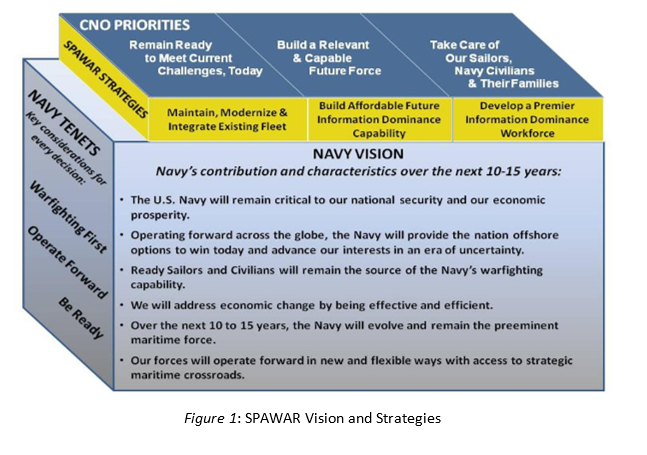
The three SPAWAR strategies include:
Maintain, modernize, and integrate the existing fleet
Build affordable future information dominance capability
Develop a premier information dominance acquisition
workforce
Each strategy feeds the guiding
principles and brings to fruition the SPAWAR vision as related to the D tenets
and vision. These factors are critical in developing the logistics and supply
chain initiatives, tas and deliverables that make
this vision a reality. SPAWAR hosts over 67 cybersecurity programs value over
$10 billion. SPAWAR is a competency-based organization with Program Executive
Offices (PEOs) were established and organized to develop, manage, and maintain
systems applicable to a System of Systems (SoS)
concept. Employees across the organization rigorously train to learn and
effectively u the DAMS process to manage program performance, costs, schedules,
and risks. Prior to explaining t DAMS process, each student is introduced to SoS systems to better understand how IT technologies a
grouped in today’s global markets.
System of Systems (SoS)
Thomas, Capshaw, and Franken
(2010) define SOS as “an amalgam of individual systems, each of wh is designed to perform a specific function” (p. 439).
SOS interoperability has caused engineering, IT, logistics challenges based on
hardware configurations and software non-compatibility based on corpor proprietary knowledge associated with the
requisition of commercial products and software technologi
Engineers “find it much easier to conduct evaluations of individual systems
because the parameters, threats, and variables that are part of the individual
system’s tests are not complicated or influenced other systems” which create
supply support and logistics challenges (Thomas, Capshaw, and Franken, 2010, p.
440). Not only are inventories and fill-rates impacted, but multiple systems
dispel complex relationships requiring disparate training, where failures are
not always prevalent. Only by testing th individual
systems versus the interoperability on ships, aircraft, or operations centers
with other operational systems, are problems identified such as degraded bandwidth,
systems glitches or failures failure at the strategic level.
Milestone A
Each program supported always
begins with the Materials Solution Analysis (MSA) and Technology Development
(TD) phases under milestone A (MS A), or the pre-systems acquisition phase. Key
logis leaders formally recognized as Product Support
Managers (PSM) are a critical part of the program management team and work
closely with engineers, finance, contracts, Information Assurance (IA),
military stakeholders and other program management personnel to determine the
weapon system ne associated to support objectives. Determining a military
warfighter need versus the supportability objectives is often the most critical
element required to initiate the acquisition process, as there is oft great ambiguity and complexity associated with the
customer need. Figure two below represents the DAMS framework surrounding
weapon system development.
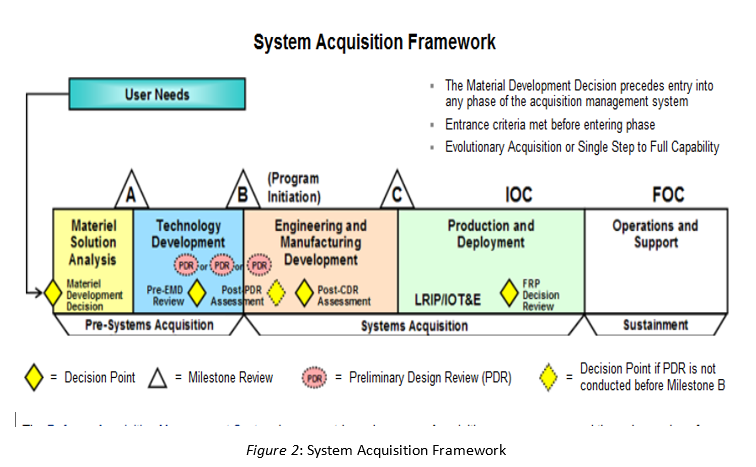
The System Acquisition Framework represents an
event-based process model followed by a series of milestones with entry and
exit decision points authorizing the transition between program phases. Th MS A
phase normally begins upon the receipt of an Initial Capabilities Document
(ICD) received from military (customer) component describing a particular weapon
system need to sustain our national security posture. By conducting an Analysis
of Alternatives (AoA) and researching alternative
maintenance and sustainment concepts across existing joint-military service
weapon systems a determination for a new weapon system or modernization of an
existing weapon system emerges.
Milestone B
The MS B is a Milestone Decision
Authority (MDA) led decision that marks the official beginning of a program. MS
B reflects the completion of the Technology Development phase certifying that
the prog is affordable and can meet the established performance objectives as
well as scheduled requirements. The Engineering and Manufacturing Development
(EMD) phase focuses on building a system or increment of capability and
designing-in critical supportability tenets to ensure material
availability and reliability with particular attention to
reducing the logistics footprint. Ultimately, the E phase efforts lead to the
integration of end-item components and subsystems into an operational and supportable
system.
Milestone C
Upon fully developing a system
that satisfies an operational capability, the next phase is the Productio and Deployment, during which the system is
piloted to an end-user. Logistics and supply activities in managing the product
baseline, risk assessments, the Life Cycle Sustainment Plan (LCSP) and other
product elements that feed the supportability and health of the program
throughout the life cycle. La the Operations and Support Phase objectives are
to execute and support the program fully in meeting performance requirements,
which includes sustaining the system in the most cost-effective manner o the total life cycle.
Total Life Cycle Systems Management
A plethora of information
follows a system throughout the entire lifecycle from conception until
disposal. Throughout each phase of the DAMS process DoD acquisition managers
conduct thorough analyses, System Engineering Technical Reviews (SETR) events
along with entrance and exit criteria (finalized system products) supporting each
milestone, but also feeding back to the organizational strategy. Strategic
factors related to logistics and supply managers include measuring the design
commonality versus unique materials based on cost factors, demand, and
availability burdens. Syste intricacies also lead to
additional maintenance schedule complexities at the organization, intermediate
and Original Equipment Manufacturer (OEM) to include higher cost burdens.
Measuring each aspect f in line with the system support plan. A Business Case Analysis
(BCA) is updated at milestones B and measure the material technology and
maturity readiness, component integration, IT commonalities, u functionality,
and cost associations, which are fed to organizational executives, known as the
Mileston Decision Authority (MDA) who approve or
disapprove the program to move forward.
References
Defense Acquisition University. (n.d.) System acquisition
framework. Retrieved from https://dap.dau.mil/aphome/das/Pages/Default.aspx
Copyright 2020 // Grantham University