Information Technology Project Management – Week #7 Lecture
What Is Project Quality?
Experts measure a project’s quality based on the conformance to
requirements of the project’s products or services, or fitness for use. Quality suggests that a project’s methods and
deliverables meet written specifications, or a projects’ delivered product can
be used as it was intended. The International Organization for Standardization
(ISO), defines quality as, “the degree to which a set of inherent
characteristics fulfills requirements.”
What Is Project Quality Management?
Project quality
management ensures that the project
outcome satisfies the business goals and other purposes for which the project
was undertaken. Project quality management
includes three processes planning quality management, performing quality
assurance, and performing quality control. Planning quality management
involves identifying standards relevant to the project, defining how to meet
the standards, and determining how to measure whether the standards were
achieved. Performing quality
assurance involves evaluating the overall project performance periodically
to ensure the project satisfies quality standards. Performing quality
control entails monitoring project results to ensure compliance with
quality standards.
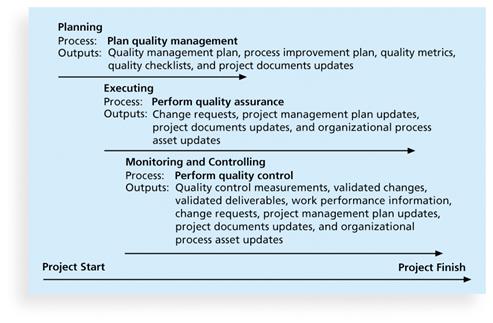
Figure 1 Project Quality Management Summary
(Schwalbe, 2015)
Planning Quality
Planning quality
management prevents defects by setting
quality standards, procedures to achieve the standards and methods to verify
that the standards were achieved.
Quality planning requires anticipation of situations that might impact
quality and preparing ways to address them.
Defects are prevented by selecting proper materials, training and
indoctrinating people in quality, and planning processes that ensure the
expected outcome. There are aspects of a
project scope that affects quality.
Clarity of the project scope and requirements is achieved between the
customer and project team to ensure the quality of the product or service
created. Scope aspects, of IT projects,
that influence quality, are functionality, features, system outputs, system
performance, system reliability, and system maintainability.
Who’s Responsible for the Quality
of Projects?
Ultimately, project managers are responsible for project quality
management. The International Organization
for Standardization (ISO)
www.iso.org, and I triple E
(IEEE) at www.ieee.org, are organizations
that project managers and teams can reference for quality information.
Performing Quality Assurance
Quality assurance consists of all the undertakings related to satisfying the project
quality standards. Continuous quality
improvement, Kaizen, a Japanese philosophy for improvement, is an
additional goal of quality assurance. Lean
is another quality assurance concept that involves processes to minimize waste
while maximizing customer value. Benchmarking
compares specific project practices and product features to other projects
and products and uses results for quality improvements. A quality audit reviews quality
management pursuits for improvements and lessons learned.
Controlling Quality
Quality acceptance or rejection decisions, rework, and process
adjustments are the main outputs of quality control. The Seven Basic Tools of Quality are, cause
and effect diagrams, quality control charts, checksheets,
scatter diagrams, histograms, Pareto charts, and flowcharts.
Testing
Many IT professionals think that testing occurs near the end of the
development lifecycle. However, testing occurs at every stage. Requirements validation is a form of testing
requirements by validating that system specifications map directly to a
functional requirement, and that functional requirements map to a business
requirement. A user test case is created for each functional requirement to
ensure that the correct tests are performed.
Unit testing is performed during development. After development, integration testing takes
place; then system testing is performed.
User acceptance testing finally occurs last before a service or product
is released. Figure 2 shows testing
tasks in the software development lifecycle.
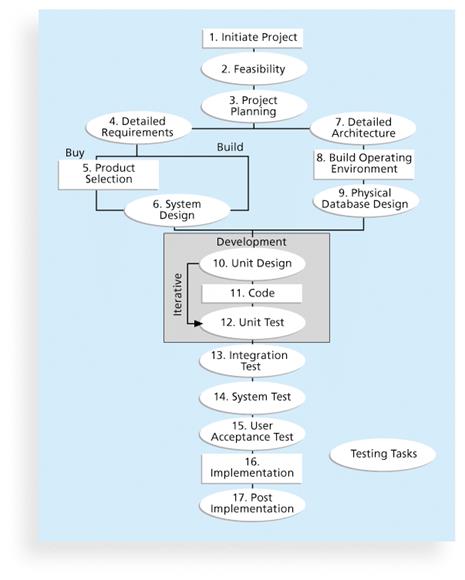
Figure 2 Testing Tasks in the Software
Development Life Cycle (Schwalbe, 2015)
Types of Tests
Unit testing
occurs as each component is developed
to ensure that it is defect-free. After
development, integration testing occurs to test functionally grouped
components. During system testing the
whole system as one entity. End users
perform user acceptance testing is before accepting the delivered
system.
Testing Alone Is Not Enough
Failure to adequately test software can be extremely costly. Watts S. Humphrey, a software quality expert,
defines a software defect as something wrong with a program; anything
that detracts from a program's ability to satisfy user needs. Defects can be identified, described, and
counted. The earlier a defect is removed in the software development cycle, the
less expensive it costs. A defect removed during the requirements phase costs
tremendously less than a defect removed after a product release. Testing does not adequately prevent software
defects. The tests performed cannot
cover all of the numerous ways a complex system can be tested. Additionally, users discover new ways to use
a system that its testers never considered.
Humphrey suggests that developers revise their processes to provide
error-free code at each stage of testing.
Modern Quality Management
Modern quality management calls for customer satisfaction, observes
management responsibility for quality, and favors prevention to
inspection. Deming, Crosby, Juran, Taguchi, Ishikawa, and Feigenbaum
are quality experts who advanced modern quality management.
Malcolm Baldrige Award
In 1987, the Malcolm Baldrige National Quality Award was created
to acknowledge companies that achieved a level of world-class competition
through quality management. The
President of the United States gives three awards each year in different
categories, manufacturing, service, small business, and education and health
care.
ISO Standards
ISO 9000 is a quality system standard that guides organizations in a continuous
cycle of planning, controlling, and documenting quality. ISO standards propose minimum requirements
needed for an organization to meet its quality certification standards. Quality standards help organizations reduce
costs and increase customer satisfaction.
Improving Information Technology Project Quality
Suggestions for improving IT project quality include:
·
Set up leadership that
encourages quality
·
Recognize the cost of quality
·
Concentrate on how
organizations and the workplace affect quality
·
Adhere to maturity models
The Cost of Quality
A study found that each year, software defects cost the US economy $59.6
billion. Better testing could eliminate
a third of the defects. The cost of
quality is the cost of nonconformance, taking responsibilities for
failures, and the cost of conformance, delivering products that meet quality
standards.
Five Cost Categories Related to Quality
–
Prevention cost is the cost
of designing and implementing a project such that it is error-free or contains
errors within an acceptable range.
–
Appraisal cost is the cost
of assessing processes and their outputs to confirm quality
–
Internal failure cost is the cost
of correcting defects before the product is delivered to the customer.
–
External failure cost is the cost
related to all errors found and corrected after delivery to the customer.
–
Measurement and test equipment costs are costs of equipment employed in defect prevention and quality
appraisal activities.
References
Schwalbe, K. (2015). Information technology project management.
Cengage Learning.