Information
Technology Project Management – Week 1 Lecture
Introduction to Project Management
What is a
Project?
A project is a
temporary endeavor, aside from normal business operations, with a goal of
developing a particular product, or service, or attaining a desired result. A
project has limited resources regarding people, time, and supplies. During
project activities, members of the project team are held accountable for the
achievement of goals and completion of the project tasks. A project begins with
a planned schedule, a specified outcome, which is its scope, and a planned
budget. The schedule, scope, and budget limit the time allotted for project
completion, the features and functionality of the final product, and the cost
of the project, respectively. These three limitations are called the triple
constraint.
Projects can be
gigantic and complex, medium-sized, or small. Projects can involve thousands of
people, hundreds, or just one individual. Projects might span decades, years,
weeks, days or just one day. IT projects may include marketing, sales,
hardware, software, communication networks, and distribution. Professionals
from various areas are assembled into a project team to realize a project from
its conception to its close.
Project
Attributes
Some project
attributes are:
- A project has a unique goal
- A project is temporary
- A project is developed using
progressive elaboration. In
the beginning, projects are broadly defined. As time passes, more people,
who can explain the project details concerning their areas of expertise,
become involved. As a result, the project details become clearer. Project
requirements become well-defined as time passes. For this reason, projects
should be developed incrementally.
- Projects require resources from
various areas - IT
projects include people across departments and other organizational
boundaries. Projects can cross external boundaries and include people from
partner companies, or outside consultants.
- A project should have a primary
customer or sponsor -A
sponsor or primary customer provides funds for a project and executive
support, which is crucial for project success
- Uncertainty is involved in a project
-External factors
can cause uncertainty such as suppliers going out of business or team
members leaving the company, or needing unplanned time off. This type of
uncertainty is a significant challenge to project management (Schwalbe,
2015).
Introduction to
Project Management Supplemental Video
Please view the
following five-minute video that gives a brief introduction to project
management. Introduction
to Project Management (KNOLSKAPE, 2013).
Triple
Constraint
A project has
limited resources in terms of time, human resources, and supplies. There is a
specified schedule that limits the time allowed for a project. There is a
specified scope that limits the goals or objectives of a project. Another
limitation is cost. A project takes place within the limits of its goals or
objectives, its schedule, and its budget. Project managers refer to these three
limitations as the triple constraint.
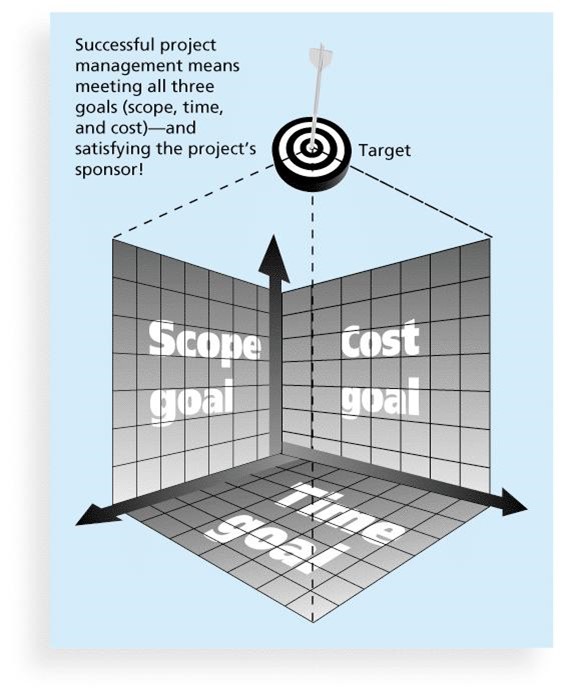
The triple
constraint limits the quality of a project’s outcome. If a project has
unlimited time, scope, and budget, the quality of its resulting product would
be very high. A goal of a project manager is to balance the time, budget and
scope constraints to produce a product or service that meets a project's
quality standards.
What
is Project Management?
A project
manager is a person authorized by a sponsoring organization to oversee a
team that will be held accountable for realizing project goals and objectives.
According to the Project Management Institute, project management is the
application of knowledge skills tools and techniques to project activities to
meet project requirements (Project Management Institute, 2013). Project
managers must not only meet the scope, time, cost, and quality goals; they must
also facilitate the entire process. Project managers must meet the expectations
of all stakeholders, those involved in project activities and those affected by
a project (Project Management Institute, 2013).
Stakeholders
Stakeholders
are people involved in
or affected by project activities. Stakeholders include the project sponsor,
the project team, customers, users, suppliers, support staff, and even
opponents of a project. Anyone affected by the project is a stakeholder.
Stakeholders have different project expectations. The sponsors expect the
project outcome to meet their business objectives. The users of the product
delivered, expect satisfaction with the quality and the ease-of-use. The
project team or the organization as a whole, expects project activities to stay
within the bounds of the scope, schedule, and budget.
Project
Management Tools and Techniques
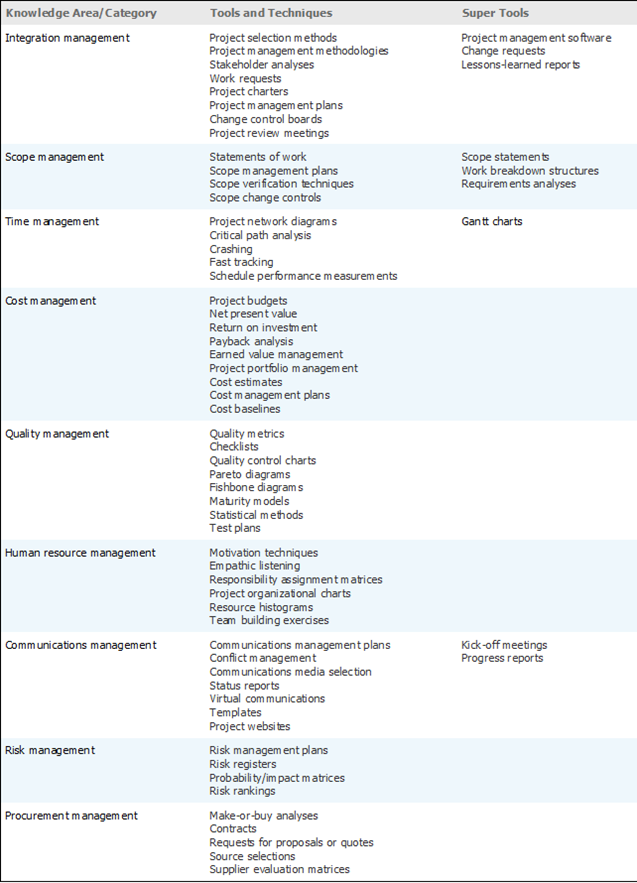
To manage
projects, project managers use some of tools and techniques listed on in Figure
2.
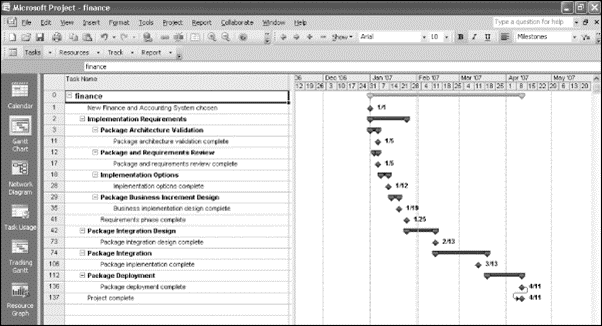
A Gantt chart,
a tool used by project managers to manage project schedules, is shown in Figure
3. The chart was created with Microsoft Project 2013.
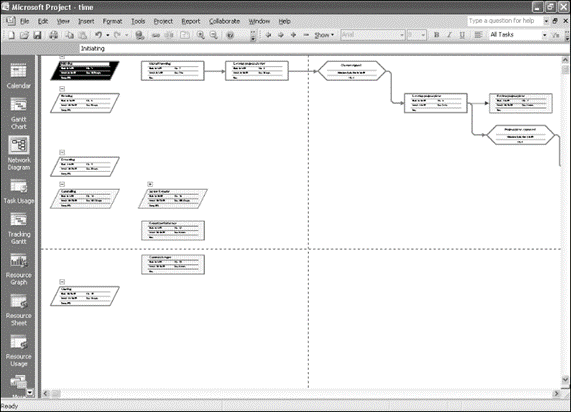
A network
diagram is another useful tool for managing project schedule. An illustration
of a network diagram created with Microsoft Project 2013 is shown in Figure 4.
Measuring Project Success
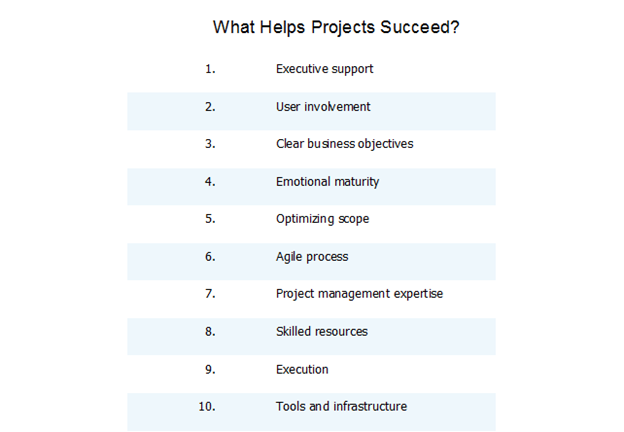
According to a
CHAOS study, the success of a project depends on the factors listed below in
Figure 5 in order of significance (Manifesto, 2013).
Performance
metrics are used to quantify project progress. Project metrics often include
customer satisfaction, return on investment, the percentage of the schedule
depleted and the amount of the budget spent. Project managers do not assume
that their criteria for success are the same as the sponsor and stakeholders.
Project managers take the time to understand the sponsor and stakeholder
expectations and track project performance based on success criteria of
different stakeholders.
Program
Management
According to
the Project Management Institute (2013), “A program is a group of related
projects, subproject programs, and program activities managed in a coordinated
way to obtain benefits and control not available from managing them
individually.” It is economical to group projects to streamline management,
staffing, purchasing, and other efforts. Companies use programs and project
portfolio management to ensure that projects are aligned with the enterprise
goals. Program managers often review important information with project
managers and coordinate functional groups, suppliers, and operations support
staff between projects in a program.
Project
Portfolio Management
Projects and
programs can be grouped and managed as a portfolio of investments that
contribute to the entire enterprise’s success. Portfolio managers help make
investment decisions by helping to select and analyze projects from a strategic
perspective.
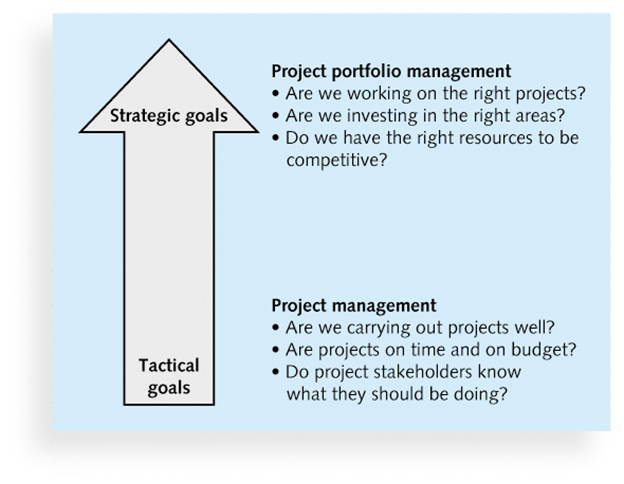
A portfolio
manager addresses questions like, “Are we working on the right projects?” “Are
we investing in the right areas?” “Do we have the right resources to be
competitive?” Before each project begins questions, “Is this project still
relevant to the enterprise?” “And, should we go ahead and start on it now, or
not?” should be asked by a portfolio manager. These are strategic questions that
a portfolio manager must ask.
References
KNOLSKAPE.
(2013). Introduction to Project Management. Retrieved from
https://www.youtube.com/watch?v=BOU1YP5NZVA
Manifesto, C.
(2013). Think Big, Act Small. The Standish Group International Inc.
Project
Management Institute. (2013). A guide to the project management body of
knowledge: (PMBOK® Guide). Newtown Square, Pa.: Project management
institute.
Schwalbe, K.
(2015). Information technology project management. Cengage Learning.