Information Systems Strategic Planning – Week #2 Lecture 1
Making "Good" Decisions
Businesses must
make decisions, good decisions every day in order to sell their products and
make a profit. Sifting through large amounts of data is a common issue in this Information
Age. Companies must gather the data, convert it in to information, perform in
depth analysis and come to a decision on basic business questions every day.
One model is the six step decision making process.
This model assists companies as they follow company procedures to come to
viable solutions.
The six-step
decision-making process:
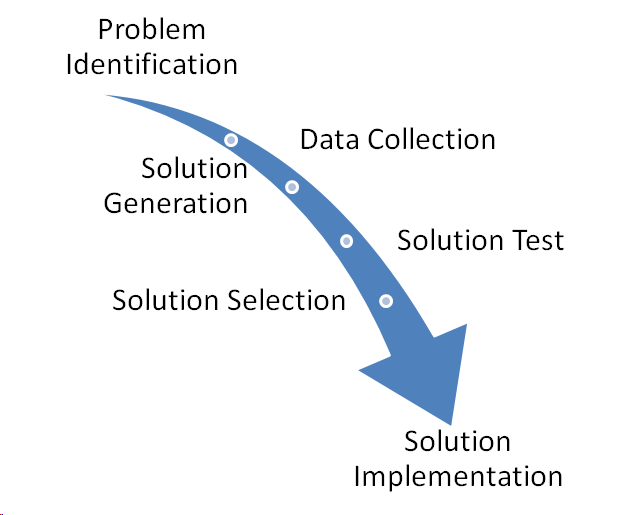
These six steps are
critical in the process of making decisions. It allows for all parts of the
issue to be addressed. Several possible solutions can
be pursued, the results tested and the best possible solution can be selected.
Businesses face
many types of issues so decisions of various areas of the company are very
different in nature. The operational side of the business makes very structured
decisions, how many widgets to manufacture and how much raw materials to
purchase are a couple of examples. Managers make decisions that are sometime
structured and sometimes unstructured, this is labeled semi-structured decision making. When the leaders of a company go off site
once a year to make long term planning decisions the decisions made are mostly
unstructured decisions.
How do business
make decisions? What types of issues require decisions to be
made? One way companies make decisions is based
on KPI (Key Performance Indicators). KPIs are like
goals, they are preselected milestones that are monitored.
If the desired level is not met then actions are taken
to see what happened. Some business will actually create a dashboard with these
indicators so that the important milestones can be monitored
in a way that is much like driving a car! Indicators can be of any concern that
is important to the business – it could be returned items, the average amount
that a customer purchases, the cost of raw materials or even turnover (employees
leaving). KPIsusually include the number
of new customers, this is an external issue being monitored.
An internal financial KPI example is ROI – return
on investment which means for every dollar
that is invested how much does the company get back?
How does the
company gather data that it turns into valuable information? Some data may be gathered by asking customers questions using tools
such as polls or surveys. Marketing firms hold focus groups so that customers
(or potential customers can voice their opinions directly. Much larger
quantities of information can be accumulated by
a transaction processing system (TPS). These systems can be very
complex but for the most part they track sales, what
item was purchased, what was the price, what was the day and time and maybe
even what else was purchased at the same time.
Enough about data let’s get back to the decision making process! There are four quantitative models that are identified as
support systems for managers
- What-if
analysis – checks
the impact of changing something
- Sensitivity
analysis – checks
the impact of changing something over and over
- Goal-seeking
analysis – sets a
target and then change other things to make it achievable
- Optimization
analysis – looks
for the best point for something to happen
Companies use these
tools to make decisions on a moment by moment basis or
once a year, depending on the issue and the company’s level of preparedness.
Making good decisions on a regular basis will help a company survive rough
economic times as well as the introduction of competition and the natural life
cycle of products. The most important thing to making decisions is following a
consistent process so that all options are reviewed
and the best possible outcome can be achieved.