Business Communications – Week 1 Lecture
Foundations of Business Communication
‘Communication’ is not simply a word used to indicate people
talking and hearing. It is much more complex than that: it is transactional,
with “each person serving as both speaker and listener, as simultaneously
communicating and receiving messages (Watzlawick, Beavin, & Jackson, 1967; Waltzlawick,
1977, 1978: Barlund, 1970). This means, that in any communication setting, there are several components
that influence participants’ ability to arrive at shared meaning, which is the desirable goal of the
communication process. After all, a person delivering a message
would like the person receiving it, to understand his or her words the same way
she or she intended them to be understood. And to receive a message, one must actively listen to it.
Hearing is a physiological process. Most of us can’t
help but to hear sound. Listening, on the other hand is a choice.
For
us to consider the communication process and how it works in our everyday
lives, we must think about listener feedback, noise that interferes in
accurate message receipt, the channels through which messages are sent and
received, and the context surrounding both the actual words of messages and the
circumstances in which they are communicated.
Examples of
Communication Process Components
Feedback
might
include nods of approval, confused looks, and utterances of agreement or
disapproval.
Noise
– There
are three primary types of noise: internal, external and semantic. Each can impact all participants in attempts to communicate.
Internal
–
thinking about something other than the message, like trying to listen to an
in-class lecture while thinking about all the tasks you need to get done when you get home from class. This type of noise
might also include personal biases, prejudices, emotional states, and day-dreaming – anything going on in the heads of the
participants that is not a part of understanding or seeking understanding.
External
– Loud
heating vents, people talking, someone tapping a pencil or even a poorly
written report interfere with message understanding or message delivery.
Semantic
– a
speaker chooses a word that you understand to be derogatory, such as using the
word ‘broad’ when referring to a woman. Or, a medical
doctor uses complex terms to explain your illness, and you do not understand
his or her message because you cannot understand the terms. In this kind of
noise, a speaker’s word choice impacts message
receipt.
Each
of these types of noise distract from the efficiency of the communication
process.
Channel
– This
refers to exactly how the message was received. Was it delivered face-to-face, email, text or some other
method? The method is the channel.
Context
-
Contexts can be historical, psychological, environmental and social.
Historical
- a
supervisor discusses an employee’s concerns with him, and tells him he will
think about how to best address them. The next day,
the supervisor passes the employee in the hallway and tells him, “I know how we
will handle it. Stop in and see me this afternoon.” The employee knows exactly
what the supervisor is referring to. Those who
overhear the exchange do not have enough information to understand the
supervisor’s message because they were not present at the original message
exchange.
Psychological
– The
moods and emotions of those involved in the communication event.
Environmental
– The
physical place in which a message is communicated.
Communication environments in include classrooms, office space, sales floors,
and factory break rooms, among a wide variety of setting, each with its unique
challenges and benefits.
Social
– The
social group a message is distributed. For example, if we were to explain a
decision to return to college as an older adult, we might choose to describe
the decision differently when talking to our grandmother who never completed
6th grade, than to our friends or supervisors.
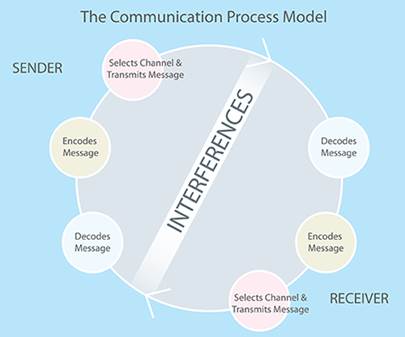
As
you can see in the Communication Process Model above, communication of the
message is an ongoing, circular event. Because words are merely symbols, we can
think about the formation of our message, and the subsequent receipt of our
message as message encoding and decoding. We choose those words that have the
best chance of being understood by our listeners as we
intend them to be meant. Noise and context can cause message interference.